I watched a Fortune 500 CEO demo their “revolutionary” AI chatbot last month. It took three tries to answer a basic customer service question, gave contradictory information about return policies, and crashed when asked about product availability. The CEO beamed with pride. “We’re now an AI-first company,” he announced to scattered applause.This scene plays out in boardrooms across America every day. According to McKinsey’s 2024 State of AI report, 73% of companies have adopted AI in at least one business function, yet only 23% report significant business impact. The gap between AI adoption and AI success has never been wider.Here’s what bugs me most: we’re treating AI implementation like buying software when it’s actually more like performing surgery. You wouldn’t let an intern operate on your brain just because they watched a YouTube video about neuroscience. Yet companies are deploying AI systems that touch every aspect of their business with about the same level of preparation.After spending two years consulting on AI implementations for mid-market companies, I’ve seen the same mistakes repeated with religious devotion. The good news? The companies that get AI implementation right aren’t necessarily the biggest or best-funded. They just avoid the predictable traps that sink everyone else.
Most AI Projects Die Because Leadership Doesn’t Understand What They’re Building
The first killer of AI implementation isn’t technical—it’s conceptual. I’ve sat through countless kickoff meetings where executives describe their AI vision using phrases like “make everything smarter” or “automate all the things.” When I ask for specific success metrics, I get blank stares or vague promises about “efficiency gains.”Consider the case of MidCorp Manufacturing (name changed), a $200M industrial supplier that decided to “go AI” in 2023. Their initial brief was a masterpiece of corporate speak: “Implement AI across all business functions to drive digital transformation and competitive advantage.” No specific problems identified. No measurable outcomes defined. No understanding of what AI could or couldn’t do for their particular business.Six months and $400,000 later, they had a collection of AI tools that nobody used. A chatbot that couldn’t answer questions about their custom products. A predictive maintenance system that generated more false alarms than a smoke detector in a college dorm. An inventory optimization algorithm that recommended stocking 10,000 units of a product they’d discontinued two years earlier.The problem wasn’t the technology—it was the complete absence of strategic thinking about AI implementation. They treated AI like a magic wand instead of a sophisticated tool that requires careful application to specific problems.Contrast this with DataFlow Logistics, a $50M shipping company that took a radically different approach. Instead of trying to “AI everything,” they identified one specific pain point: their customer service team spent 60% of their time answering the same five questions about shipment status. They built a simple AI system that could handle these routine queries, freeing up humans for complex problem-solving.The results? Customer satisfaction scores increased 23% in six months. Response times dropped from an average of 4 hours to 12 minutes. Most importantly, the AI implementation paid for itself within 90 days through reduced labor costs and improved customer retention.The difference between these companies wasn’t technical sophistication—it was clarity of purpose. DataFlow knew exactly what problem they were solving and how they’d measure success. MidCorp was chasing the AI trend without understanding what they were actually trying to accomplish.This pattern repeats across industries. Gartner’s 2024 AI Implementation Study found that projects with clearly defined success metrics were 4.2 times more likely to deliver measurable business value. Yet 67% of AI initiatives begin without specific, quantifiable goals.The fix isn’t complicated, but it requires discipline. Before writing a single line of code or evaluating any AI platforms, leadership must answer three questions: What specific business problem are we solving? How will we measure success? What happens if this AI system fails completely?If you can’t answer these questions in one sentence each, you’re not ready for AI implementation. You’re ready for more planning.
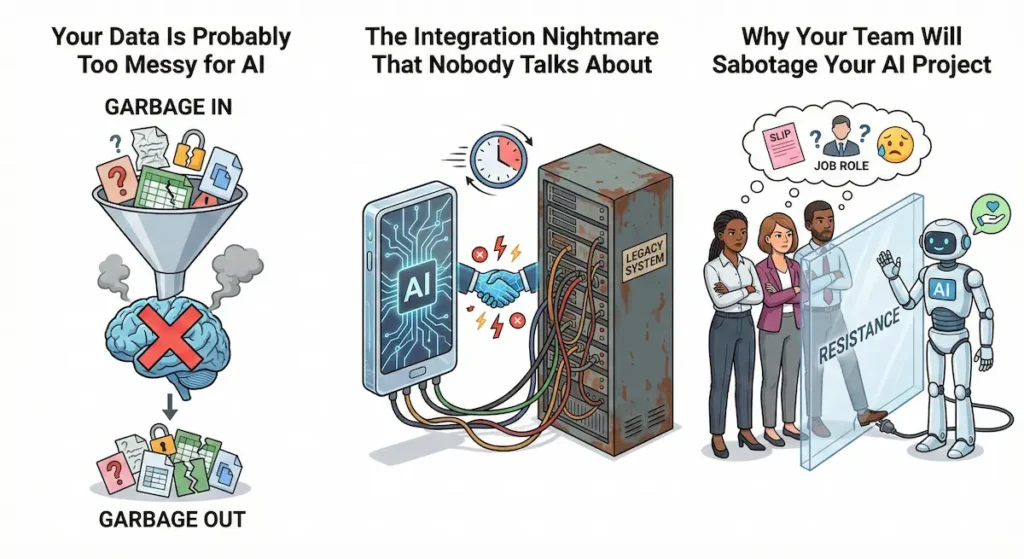
Your Data Is Probably Too Messy for AI (And That’s Killing Your Results)
Here’s an uncomfortable truth about AI implementation: garbage in, garbage out isn’t just a saying—it’s the law of the universe. I’ve never seen an AI project succeed with poor data quality, and I’ve seen dozens fail because companies underestimated the data preparation required.Take RetailPlus, a regional clothing chain that wanted to implement AI for inventory forecasting. They had 15 years of sales data across 47 stores. Sounds perfect for machine learning, right? Wrong. When we audited their data, we discovered a horror show that would make a data scientist weep.Product codes had changed three times over 15 years, with no mapping between old and new systems. Seasonal items were categorized differently across stores. Returns were sometimes recorded as negative sales, sometimes as separate transactions, and sometimes not recorded at all. Store #23 had been logging all transactions as “miscellaneous” for eight months because their point-of-sale system was “acting weird.”The AI model trained on this data was worse than useless—it was confidently wrong. It predicted massive demand for discontinued products, recommended clearing out inventory of their best sellers, and suggested ordering 500 winter coats in July for their Miami location.Data quality issues sink AI implementations faster than any technical challenge. According to IBM’s 2024 Data Quality Report, poor data quality costs organizations an average of $12.9 million annually. For AI projects specifically, the impact is even more severe because machine learning algorithms amplify data problems rather than correcting them.The most successful AI implementations I’ve seen spend 60-70% of their time and budget on data preparation. This isn’t glamorous work—it’s the digital equivalent of cleaning out your garage before organizing it. But it’s absolutely essential.Consider TechFlow Solutions, a B2B software company that wanted to implement AI for lead scoring. Instead of rushing into model development, they spent three months auditing and cleaning their CRM data. They discovered that 34% of their “leads” were actually existing customers, 18% had invalid contact information, and their sales team had been using the “notes” field as a dumping ground for everything from meeting summaries to lunch orders.The data cleaning process was tedious and expensive—$80,000 in consultant fees plus hundreds of hours of internal work. But the resulting AI system achieved 89% accuracy in predicting which leads would convert to sales, compared to the 34% accuracy their sales team achieved using intuition alone.More importantly, the data cleaning process revealed insights that were valuable independent of AI. They discovered that leads from certain marketing channels had a 3x higher conversion rate, that their most successful salespeople were focusing on completely different prospect characteristics than company training recommended, and that their “high-value” leads were actually less likely to close than mid-tier prospects.The lesson here isn’t just about data quality—it’s about understanding your business deeply enough to implement AI effectively. Companies that skip the data audit phase aren’t just setting up their AI for failure; they’re missing opportunities to understand what’s actually happening in their business.If you’re serious about AI implementation, start with a comprehensive data audit. Map every data source, document every transformation, and test every assumption. It’s not exciting work, but it’s the foundation that determines whether your AI implementation succeeds or becomes another expensive lesson in the importance of preparation.
The Integration Nightmare That Nobody Talks About
AI demos are seductive. Watch a sleek presentation where an AI system seamlessly analyzes data, generates insights, and automates decisions, and you’ll start imagining how it could transform your business. What these demos don’t show is the months of integration hell required to connect AI systems to your existing technology stack.I learned this lesson the hard way while helping GlobalTech Services implement an AI-powered customer support system. The AI itself worked beautifully in isolation—it could understand customer queries, access relevant information, and generate helpful responses. The problem was getting it to work with their existing systems.Their customer data lived in Salesforce. Their product information was stored in a custom database built in 2003. Their ticketing system was a third-party tool that didn’t play nicely with modern APIs. Their knowledge base was a collection of Word documents stored on a shared drive. Getting the AI to access and synthesize information from all these sources required building custom integrations for each system.What should have been a three-month implementation stretched to eight months. The integration work cost more than the AI system itself. Worse, every time one of their legacy systems updated, something broke in the AI integration, requiring additional development work to fix.This integration complexity is the hidden killer of AI implementations. Forrester’s 2024 AI Integration Report found that 58% of AI projects exceed their original timeline, with integration challenges being the primary cause of delays. The average AI implementation requires connecting to 7.3 different systems, each with its own data formats, security requirements, and technical constraints.The companies that succeed at AI implementation plan for integration complexity from day one. They audit their existing technology stack, identify potential integration points, and budget significant time and resources for connecting systems that were never designed to work together.ManufacturingCorp took this approach when implementing AI for predictive maintenance. Before selecting an AI platform, they mapped every system that would need to connect: their industrial IoT sensors, their maintenance management software, their inventory system, their scheduling platform, and their financial reporting tools.They discovered that their 15-year-old maintenance management system couldn’t export data in any modern format. Rather than trying to build a complex integration, they used the AI implementation as an opportunity to upgrade to a modern system that could communicate effectively with AI tools.This decision added $150,000 to their project budget but saved them months of integration headaches. More importantly, it positioned them for future AI implementations by creating a more connected, modern technology foundation.The lesson here is counterintuitive: sometimes the best AI implementation strategy is to fix your existing systems first. If your technology stack looks like a museum of computing history, you’re not ready for AI. You’re ready for modernization.Smart companies use AI implementation as a forcing function to address technical debt they’ve been avoiding for years. They recognize that AI isn’t just another software tool—it’s a capability that requires a modern, integrated technology foundation to deliver value.
Why Your Team Will Sabotage Your AI Project (And How to Prevent It)
Image: Google DeepMind / Pexels
The most sophisticated AI system in the world is worthless if your team won’t use it. I’ve watched brilliant AI implementations fail not because of technical problems, but because the people who were supposed to benefit from them actively worked to undermine their success.At ServiceFirst Insurance, we built an AI system that could process claims 10x faster than human adjusters. The technology worked flawlessly in testing. The business case was compelling—faster claims processing meant happier customers and lower operational costs. The rollout was a disaster.The claims adjusters, who had decades of experience evaluating complex cases, saw the AI as a threat to their expertise and job security. They found creative ways to work around the system: submitting claims with incomplete information that would force manual review, categorizing routine claims as “complex” to bypass AI processing, and highlighting every minor error the AI made while ignoring the thousands of cases it handled correctly.Within six months, management was questioning whether the AI system was actually improving anything. Claims processing times hadn’t improved because most claims were still being handled manually. Customer satisfaction hadn’t increased because the adjusters were spending more time fighting the AI than serving customers.The problem wasn’t the technology—it was the complete failure to address the human side of AI implementation. Nobody had explained to the adjusters how the AI would enhance their work rather than replace it. Nobody had involved them in the design process. Nobody had addressed their legitimate concerns about how AI would affect their roles and career prospects.Contrast this with the approach taken by LogisticsPro, a freight management company that implemented AI for route optimization. Instead of surprising their drivers with a new AI system, they involved them in the development process from the beginning.They held focus groups to understand what frustrated drivers about current routing systems. They discovered that drivers often knew about traffic patterns, construction delays, and customer preferences that weren’t captured in any database. Rather than treating this knowledge as obsolete, they built feedback mechanisms that allowed drivers to teach the AI system about real-world conditions.The result was an AI system that drivers actually wanted to use because it made their jobs easier rather than threatening their expertise. Route efficiency improved 31%, driver satisfaction increased, and the AI system got smarter over time as drivers contributed their local knowledge.According to MIT’s 2024 Workplace AI Study, employee resistance is the primary factor in AI implementation failures, affecting 71% of projects. The study found that companies with formal change management processes were 3.4 times more likely to achieve successful AI adoption.Successful AI implementation requires treating people as partners, not obstacles. This means involving key users in the design process, clearly communicating how AI will enhance rather than replace human capabilities, and providing training that helps people work effectively with AI systems.It also means being honest about how AI will change roles and responsibilities. Pretending that AI won’t affect jobs is dishonest and counterproductive. Smart companies acknowledge that AI will change how work gets done, then invest in helping their people develop new skills that complement AI capabilities.The most successful AI implementations I’ve seen create new roles that combine human judgment with AI capabilities. Claims adjusters become claims strategists who handle complex cases while AI handles routine ones. Customer service representatives become customer success specialists who focus on relationship building while AI handles information requests.This isn’t just about managing change—it’s about designing AI implementations that make your team more valuable, not less relevant. Companies that get this right don’t just avoid resistance; they create enthusiasm for AI adoption because people see how it enhances their capabilities and career prospects.
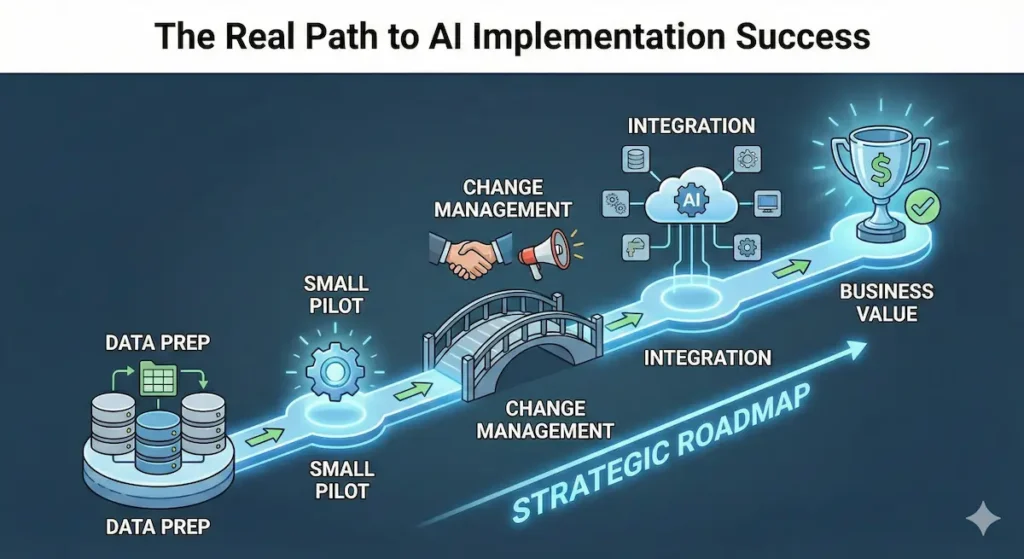
The Real Path to AI Implementation Success
After watching dozens of AI implementations succeed and fail, I’ve identified the patterns that separate winners from expensive lessons. The companies that succeed at AI implementation don’t necessarily have the best technology or the biggest budgets. They have the discipline to follow a proven process that addresses both technical and human challenges.First, they start small and specific. Instead of trying to transform their entire business with AI, they identify one high-impact, low-complexity use case and execute it flawlessly. This builds internal confidence, demonstrates value, and creates a foundation for more ambitious AI projects.TechStart Solutions exemplifies this approach. As a growing software company, they could have implemented AI for customer support, sales forecasting, product development, and marketing optimization. Instead, they focused on one specific problem: their customer success team was spending 40% of their time manually categorizing support tickets.They built a simple AI system that could automatically categorize tickets with 94% accuracy. The project took six weeks, cost $25,000, and saved 15 hours per week of manual work. More importantly, it proved to the entire organization that AI could deliver real value without disrupting existing workflows.This success gave them credibility and budget for their next AI project: predicting which customers were likely to churn. Because they’d already proven their ability to implement AI successfully, they got full organizational support and completed the project in four months.Second, successful companies invest heavily in data infrastructure before implementing AI. They recognize that AI is only as good as the data it’s trained on, and they’re willing to spend months cleaning, organizing, and standardizing their data before building any AI models.Third, they treat AI implementation as a business transformation project, not a technology project. They involve stakeholders from across the organization, invest in change management, and design AI systems that enhance human capabilities rather than replacing them.Fourth, they plan for integration complexity from day one. They audit their existing technology stack, identify potential integration challenges, and budget significant time and resources for connecting AI systems to their existing tools and processes.Finally, they measure everything. They establish clear success metrics before starting implementation, track progress religiously, and aren’t afraid to pivot if their initial approach isn’t working.The companies that follow this process aren’t just implementing AI—they’re building organizational capabilities that will serve them for years to come. They’re creating cultures that embrace technological change, data-driven decision making, and continuous improvement.Most importantly, they’re proving that AI implementation success isn’t about having the most advanced technology or the biggest budget. It’s about having the discipline to do the hard work of understanding your business, preparing your data, and engaging your people in the transformation process.The AI revolution isn’t coming—it’s here. The question isn’t whether your company will implement AI, but whether you’ll do it right the first time or learn expensive lessons from preventable mistakes. The choice is yours, but the window for competitive advantage through AI implementation is closing fast.What will you do differently to ensure your AI implementation succeeds where so many others have failed?