
AI Intelligence Report
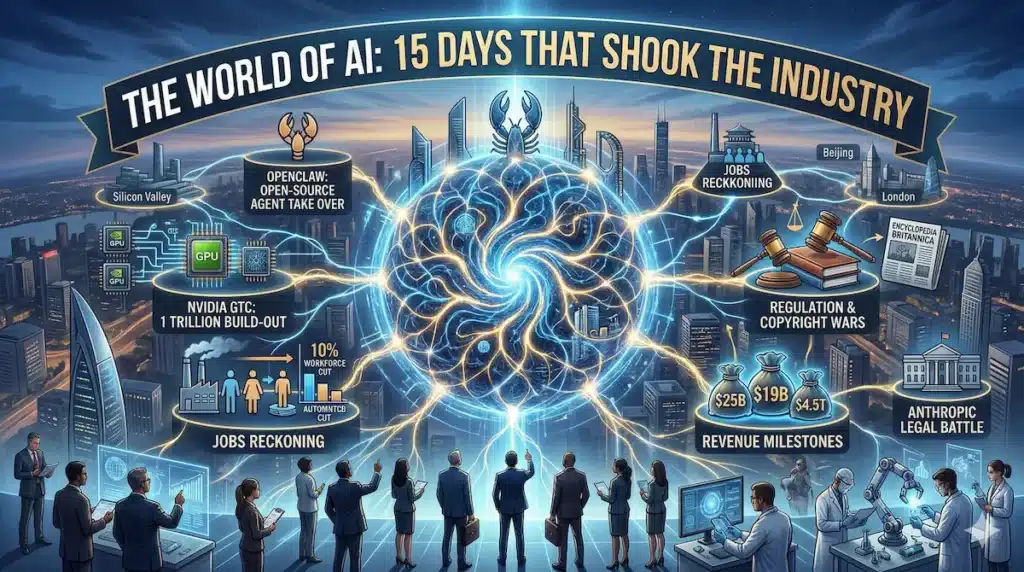
The World of AI: 15 Days That Shook the Industry
Special Report | March 9–23, 2026 | As of March 23, 2026
The past two weeks have confirmed what industry insiders have long suspected: artificial intelligence has crossed the threshold from promising technology to foundational infrastructure. From a game-changing open-source agent platform that took Silicon Valley by storm, to a landmark chip conference forecasting a trillion-dollar buildout, the period of March 9–23, 2026 delivered developments that will reverberate across business, geopolitics, and everyday life for years to come.
1. OpenClaw: The Open-Source Agent That Took Over the World
The single biggest story of the fortnight was OpenClaw — a lobster-themed, open-source agentic AI platform built by an independent Austrian developer that exploded into mainstream consciousness with a speed nobody anticipated. At NVIDIA’s marquee GTC 2026 conference, CEO Jensen Huang dedicated a significant portion of his keynote to the platform, declaring it the next ChatGPT and noting that it “exceeded what Linux did in 30 years” in a matter of weeks.
OpenClaw’s rise exposed a structural tension in the AI industry: it proved that fully autonomous AI agents can run at home without relying on the major hyperscalers, triggering fears of model commoditisation. In China, tech giants including Baidu publicly encouraged citizens to install OpenClaw on their laptops and phones. In the United States, OpenAI CEO Sam Altman announced that OpenClaw’s creator, Peter Steinberger, was joining OpenAI and that the project would live on as an open-source initiative under OpenAI’s stewardship.
NVIDIA moved to capitalise on the phenomenon by announcing NemoClaw — an enterprise-grade security and deployment layer built on top of OpenClaw — to help large businesses overcome the security hesitations preventing wide corporate adoption.
2. NVIDIA GTC 2026: Agentic AI at the Inflection Point
NVIDIA’s annual GPU Technology Conference (March 16–19, San Jose) was arguably the most consequential gathering in the tech calendar this year. Jensen Huang opened to a capacity crowd at the SAP Center, framing the “token” as the new unit of modern civilisation — the building block behind scientific discovery, virtual worlds, and physical machines.
Key hardware announcements centred on the Vera Rubin architecture — NVIDIA’s successor to Blackwell — which boasts a new combined GPU-HBM memory design offering roughly 3–4x compute density improvements and significantly better energy efficiency per FLOP. Huang also unveiled the Groq 3 Language Processing Unit (LPU), the first chip born of NVIDIA’s $20 billion acquisition of Groq in December 2025, expected to ship in Q3 2026.
On the software side, NVIDIA launched its Agent Toolkit, an open platform for building autonomous, self-evolving enterprise AI agents, backed by major partners including Adobe, Atlassian, Cisco, SAP, Salesforce, and ServiceNow. Huang declared that agentic AI had reached an “inflection point,” fundamentally shifting computing needs from training toward high-speed inference at scale.
In robotics and physical AI, NVIDIA announced that “every industrial company will become a robotics company,” unveiling Cosmos world models, Isaac humanoid systems, and a Physical AI Data Factory blueprint. Automotive partners including Uber, Nissan, BYD, and Hyundai were named as builders of Level 4 autonomous vehicles on NVIDIA’s Drive Hyperion platform.
3. The Model Race Continues: GPT-5.4, Gemini 3.1, and the Commoditisation Question
The model release cadence, already breathless, showed no sign of slowing. OpenAI launched GPT-5.4 on March 5, purpose-built for professional and agentic workflows with the ability to autonomously browse websites, fill forms, and manipulate documents. The model supports up to one million tokens of context and powers a new ChatGPT-for-Excel add-in. By March 11, older GPT-5.1 variants were retired.
Google’s Gemini 3.1 Flash-Lite pushed the cost-efficiency frontier, delivering 2.5x faster responses at just $0.25 per million input tokens. Alibaba’s open-source Qwen3.5-9B made headlines by reportedly outperforming OpenAI’s gpt-oss-120B on key benchmarks while running on a standard laptop — a sign that the capability gap between open and closed models is narrowing rapidly.
Q1 2026 as a whole has seen unprecedented release velocity, with major labs tracking 255+ model releases across organisations. Industry analysts now describe frontier model performance as approaching commodity status — a prospect that has unsettled investors in pure-play model companies but delighted enterprise buyers watching costs plummet.
4. Anthropic’s Legal Battle, the Anthropic Institute, and a Milestone Moment
Anthropic found itself at the centre of a headline-grabbing legal dispute after the Pentagon designated it a “supply chain risk” — a move the company is actively contesting in court. In a remarkable show of solidarity, roughly 40 employees from rival firms Google and OpenAI, alongside Microsoft, filed statements in support of Anthropic, arguing that the designation was unfair retaliation and set a dangerous precedent for the entire US AI industry.
On the product side, Anthropic rolled out memory features to all Claude users in early March, enabling the assistant to retain context and preferences across conversations. The company also launched The Anthropic Institute on March 11 — an interdisciplinary initiative designed to study how increasingly powerful AI systems will reshape jobs, the economy, and the legal system.
In a remarkable moment for AI capability research, legendary computer scientist Donald Knuth published a paper titled “Claude’s Cycles” on March 10, opening with the exclamation “Shock! Shock!” — expressing astonishment that Anthropic’s Claude Opus 4.6 had independently solved a complex open problem in graph theory that Knuth had spent weeks attempting while preparing The Art of Computer Programming.
5. The AI Jobs Reckoning: Layoffs, Restructuring, and the Workforce Debate
AI’s impact on employment moved from the abstract to the concrete this fortnight. Atlassian CEO Mike Cannon-Brookes announced on March 11 that the company was cutting approximately 10% of its workforce — around 1,600 employees — explicitly to “self-fund further investment in AI and enterprise sales.” The company acknowledged that AI changes the mix of skills required and the number of roles needed, describing the move as adaptation rather than replacement.
Atlassian was not alone. Oracle has announced plans to cut 20,000–30,000 employees to redirect $8–10 billion toward AI infrastructure, while Crypto.com trimmed roughly 12% of its workforce, explicitly citing roles that “do not adapt” to AI integration. A Pew Research survey published March 12 found that Americans are increasingly anxious about AI’s impact on creativity, relationships, and employment — with widespread calls for stronger regulation.
6. Regulation, Copyright Wars, and the Policy Frontier
The legal and regulatory landscape continued its rapid evolution. Vermont became one of the first US states to enact a law explicitly governing the use of synthetic media in election campaigns, signed by Governor Phil Scott on March 5. New York’s Senate advanced a suite of AI transparency and disclosure bills, including legislation requiring AI training data transparency and provenance data on synthetic content.
In Europe, the EU’s AI Code of Practice moved closer to finalisation, with the Commission collecting feedback on a draft through March ahead of the AI Act’s August 2026 effective date. The UK’s ICO and Ofcom jointly demanded information from Elon Musk’s xAI regarding its Grok model, following investigations opened in early 2026 into the model’s image generation capabilities.
On the copyright front, Encyclopedia Britannica and Merriam-Webster filed a landmark lawsuit against OpenAI, alleging the scraping of nearly 100,000 copyrighted articles for model training and — in a novel legal argument — targeting OpenAI’s retrieval augmented generation (RAG) workflow for reproducing copyrighted content in responses.
7. Business and Market Signals: Revenue Milestones and a Commoditisation Warning
The AI industry’s financial momentum remained extraordinary. OpenAI surpassed $25 billion in annualised revenue and is reportedly preparing early steps toward a public listing, potentially as soon as late 2026. Rival Anthropic is approaching $19 billion in annualised revenue. NVIDIA, the world’s most valuable public company at approximately $4.5 trillion, reported that quarterly revenue would surge roughly 77% year-over-year to around $78 billion — its eleventh straight quarter of revenue growth above 55%.
AI-driven advertising is projected to grow 63% in 2026, reaching $57 billion and reshaping the digital marketing industry. Google signalled it is exploring advertising within its Gemini AI interface, potentially creating a new conversational ad format. OpenAI expanded its advertising pilot by partnering with ad-tech platforms to integrate sponsored products directly into ChatGPT conversations.
Yann LeCun, Meta’s former chief AI scientist, raised over $1 billion for his new startup AMI to build open-source “world models,” arguing that true human-level intelligence requires AI that understands the physical world. Meanwhile, high-profile startup Reflection AI — reportedly raising $2 billion at a $20 billion valuation — faced scrutiny over its lack of public outputs, with its promised trillion-parameter open-weight model still unreleased.
Editor’s Note
The 15 days covered in this report are not an anomaly — they are the new normal. AI is no longer a story about what machines might one day do; it is a story about what machines are doing right now, to economies, to workforces, to legal systems, and to the fundamental architecture of computing. The organisations and individuals who treat this as background noise do so at their peril.
Report compiled as of 23 March 2026 • All developments subject to ongoing updates