

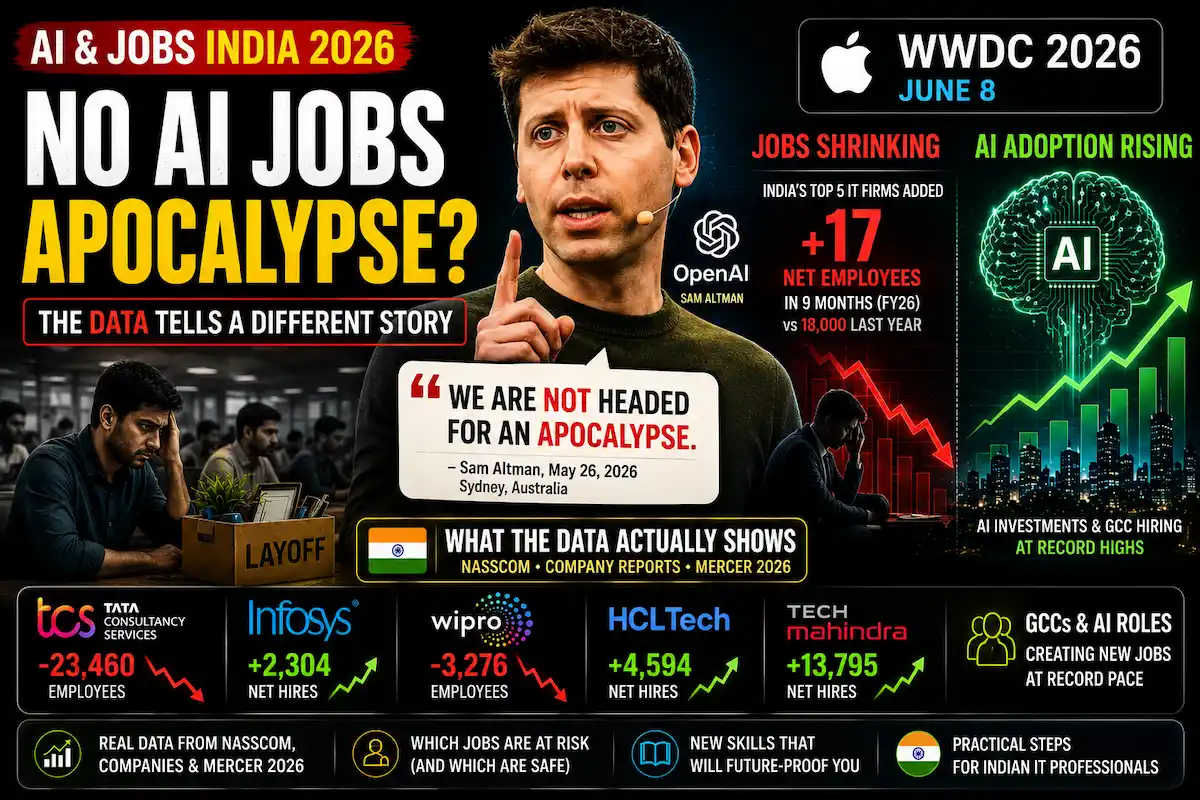
On May 26, 2026, Sam Altman stood on a stage in Sydney and said there would be no AI job replacement apocalypse. Six days earlier, Meta had laid off 8,000 people. In the same week, India’s top five IT companies — TCS, Infosys, Wipro, HCLTech, and Tech Mahindra — had collectively added 17 net employees in the first nine months of the fiscal year, compared to 18,000 in the same period a year before.
The gap between what industry leaders are saying and what the data is showing has never been wider. This article does not pick a side. It looks at the actual numbers for AI job replacement India 2026 — what is happening, what is not, and what Indian IT professionals should actually do about it.

What Sam Altman Said vs What the Data Shows
Sam Altman’s exact words on May 26, 2026 in Sydney: “I don’t think we’re going to have the kind of jobs apocalypse that some of the companies in our space advocate or talk about.” He said he would be “delighted to be wrong.”
This is a significant shift from his earlier positions. Altman had previously stated AI would “probably replace most of the jobs people do today” and that entire job categories would be “totally, totally gone.” Dario Amodei of Anthropic had projected AI could eliminate up to 50% of entry-level white-collar jobs within five years.
What the independent data shows
825/dayAverage daily layoff rate in 2026
33%Faster pace than same period in 2025
99%C-level execs planning AI-driven headcount cuts (Mercer)
The Yale Budget Lab found in a May 2026 study that AI was likely not the primary reason for the current weakening labour market — yet. The “yet” is doing a lot of work in that sentence. The study noted that meaningful displacement in AI-exposed roles had not yet shown up in unemployment data through March 2026.
The distinction matters: we are in the early innings of displacement, not the aftermath. The jobs that AI will replace have not all been replaced yet. That is not reassuring — it is a forecast.
At the India AI Impact Summit in February 2026, Altman told CNBC-TV18 that some companies were engaging in “AI washing” — blaming layoffs on AI that they would have carried out anyway. This is an important nuance. Not all tech layoffs in 2026 are AI-driven. But the ones that are AI-driven are real, and concentrated in specific roles.
AI Job Replacement India 2026 — The Real IT Numbers
Here is the honest picture from Indian IT company reports and Nasscom data for FY26:
| Company | Net Headcount Change FY26 | Key Context |
|---|---|---|
| TCS | –23,460 employees | Pivoting to AI-first services model; continued fresher hiring at lower volumes |
| Infosys | Reduced, but targeting 20,000 fresher hires FY26 | 18,000 freshers already onboarded; selective senior cuts in legacy roles |
| Wipro | Fresher hiring guidance cut to 7,500–8,000 | Down significantly from earlier estimates; AI tools replacing entry-level coding tasks |
| HCLTech | Marginal | Holding headcount; shifting mix toward AI and cloud profiles |
| Tech Mahindra | Marginal | Active restructuring; AI-first strategy announcement in Q3 FY26 |
| Top 5 combined | +17 net employees (9 months) | vs +18,000 in the same period one year earlier — a 99.9% collapse in net hiring |

Which Jobs Face AI Job Replacement in India
The displacement in 2026 is not random. It is concentrated in specific role types, and understanding the pattern is more useful than the aggregate numbers.
Roles facing direct AI displacement in India
| Role Type | Displacement Level | What Is Replacing It |
|---|---|---|
| L1 software testing / QA | High — active displacement | AI test generation tools (GitHub Copilot, Cursor, proprietary tools) |
| Basic code writing / boilerplate | High — active displacement | AI coding agents; Claude Code, Copilot, Gemini Code Assist |
| Data entry / document processing | Very High — near complete | Document AI, OCR+LLM pipelines |
| L1 customer support (voice/chat) | Medium-High — accelerating | AI chatbots (Tidio, Intercom Fin, Freshchat); resolution rates 40–50% |
| Basic content writing / SEO articles | Medium — ongoing | LLMs; human editors still required for quality control |
| Junior business analysis (requirements docs) | Medium — emerging | AI can draft PRDs, user stories, test cases from minimal input |
| Senior architecture, complex engineering | Low — AI is a tool, not a replacement | AI assists but human judgment still required |
| AI/ML engineering, data science | Growing — strong demand | This is where hiring is happening, not declining |
The pattern is consistent across every data source: AI is replacing the work, not always the worker immediately. A developer who previously needed 3 junior colleagues to handle boilerplate, testing, and documentation now uses AI tools to do that work alone. The three junior roles do not get filled when they become vacant. Net hiring collapses — which is exactly what the TCS and Wipro data shows.

The GCC Opportunity Nobody Is Talking About
Here is the piece of the India jobs story that gets underreported: while the listed Indian IT majors are cutting or freezing hiring, Global Capability Centres (GCCs) are the strongest hiring market in India in 2026.
Walmart, JPMorgan, Goldman Sachs, Shell, Apple, Google, Microsoft, and dozens of Fortune 500 companies are expanding their India GCC presence in Bengaluru, Hyderabad, and Pune.
What they are hiring for: AI/ML engineers, data scientists, cloud architects, product managers, cybersecurity specialists. These are not the legacy IT services roles that are being cut. They are the roles that AI is enabling — humans who can build, deploy, and manage AI systems.
The Indian IT labour market is not contracting. It is bifurcating. Legacy IT services roles at TCS and Wipro are declining. AI-native roles at GCCs, product companies, and AI startups are expanding. The question for individual Indian IT professionals is simple: which side of that bifurcation are you on?
Where the hiring is happening in India right now
- AI/ML roles: highest salary premiums in the market, chronic shortage of skilled candidates
- GCC product roles: Walmart Global Tech, Goldman Sachs Bengaluru, JPMorgan India — paying above Indian IT average
- Cybersecurity: demand driven by compliance requirements, AI-specific threat surface expanding
- Prompt engineering and AI ops: newer roles, growing fast, not yet commoditised
- AI product management: bridge between business requirements and AI capability — small talent pool
AI Washing — When Layoffs Get Blamed on AI Unfairly
Altman’s “AI washing” observation at the India AI Impact Summit deserves more attention than it got. He noted that some companies are attributing layoffs to AI that they would have executed regardless — for reasons of overhiring during 2020–2022, rising interest rates, demand slowdowns, or margin pressure.
This matters for Indian IT workers interpreting their own situation correctly. If your role is being eliminated and the company cites “AI-driven transformation,” ask yourself:
- Was this role likely to be cut regardless of AI? (Over-hired post-COVID cohort?)
- Is there an actual AI tool doing my specific work, or is this a restructuring dressed up in AI language?
- Is the company actually deploying AI internally, or just using “AI strategy” as a narrative?

How to Protect Yourself From AI Job Replacement in India
The AI job replacement India 2026 data points to three clear strategic responses. None of them involve waiting to see what happens.
1. Identify whether your specific role is in the displacement zone
The table above gives the honest answer by role type. If your primary work is L1 testing, boilerplate code, or document processing — you are in the highest displacement zone. If you are a senior architect, AI/ML engineer, or product leader, you are in the growing zone. If you are somewhere in between, the question is which direction your role is moving.
2. Learn AI as a productivity multiplier, not a curiosity
The developers keeping their jobs at TCS and Wipro in 2026 are the ones using AI tools to do what three people previously did. The ones being let go are the ones who never adopted AI workflows. This is not speculation — it is the hiring and retention pattern visible in company reports.
Specific skills that are currently protecting Indian IT professionals: GitHub Copilot proficiency, prompt engineering for code generation, LLM API integration, RAG architecture, cloud AI services (AWS Bedrock, Google Vertex, Azure AI).
3. Look at the GCC and product company market, not just the listed IT majors
If you are measuring your job market by TCS and Wipro’s hiring headlines, you are looking at the wrong indicator. The GCC market in India is the fastest-growing employment segment for English-proficient tech workers. The companies actively hiring are not the ones dominating Indian IT news coverage.
Frequently Asked Questions
Will AI replace Indian IT jobs completely?
No — the aggregate Indian IT workforce is actually growing, reaching 59 lakh (5.9 million) employees in FY26 per Nasscom. However, specific role categories are declining sharply: L1 testing, boilerplate coding, document processing, and basic data entry are facing active AI displacement. The growth is happening in AI/ML, GCC product roles, cybersecurity, and cloud architecture. The industry is not disappearing — it is restructuring around AI capability.
Why did TCS cut 23,460 employees if AI is not apocalyptic?
TCS’s cuts are concentrated in traditional IT services roles that AI tools are replacing — specifically L1 testing, repetitive code tasks, and legacy system maintenance work. Simultaneously, TCS is hiring for AI, cloud, and data roles. The company is restructuring its workforce mix, not eliminating it entirely. This is the pattern across all the major Indian IT firms: cutting legacy roles, adding AI-native roles, resulting in near-zero net headcount change at the aggregate level.
What is the most in-demand IT skill in India in 2026?
AI/ML engineering is the highest-premium skill in the Indian IT market in 2026, with significant shortage of qualified candidates relative to demand. Adjacent high-demand skills: RAG architecture, LLM API integration, cloud AI services (AWS Bedrock, Google Vertex AI, Azure OpenAI), and AI product management. Prompt engineering has become a baseline expectation rather than a specialisation at senior levels.
Are GCC jobs better than TCS or Infosys jobs for Indian professionals?
GCC roles (at Walmart Global Tech, JPMorgan, Goldman Sachs, Shell, Apple India, etc.) typically offer higher base salaries and more direct exposure to cutting-edge technology stacks than traditional IT services roles at the Indian majors. The trade-off: GCC roles often require more specialised skills, and the work culture is more product/engineering focused rather than services delivery focused. For AI-skilled professionals, GCC roles in Bengaluru and Hyderabad are currently the best-paying and most stable employment option in the Indian IT market.
Should I be worried about AI replacing my IT job in India?
If your work primarily involves L1 testing, repetitive coding, data entry, or document processing — yes, you should be actively reskilling. Not because your job will disappear overnight, but because the demand for those skills is declining and the window for transition is open now. If your work involves complex system design, AI implementation, product thinking, or client-facing problem solving — the risk is lower and the demand for AI-augmented versions of those roles is growing. The correct response in either case is the same: learn AI tools as productivity multipliers and position yourself in the growing segment of the market, not the declining one.
Related Articles
AI CAREERS
Best AI Jobs for Beginners in India 2026
The specific roles that are growing — with salary ranges and skills required for each.
AI LEARNING
8 Free AI Courses Every Indian Professional Needs in 2026
The specific courses that move the needle — not generic certificate programmes.
AI FOR BUSINESS
Best AI Tools for Small Business India 2026
How Indian SMBs are using AI to do more with the same headcount — the practical guide.
EARN WITH AI
How to Earn Money With AI in India 2026
For IT professionals exploring income outside traditional employment — the real options in India.
Data sources: LayoffTrends India, Nasscom FY26 Report, Time Magazine, Mercer C-Suite Survey 2026, company quarterly reports. Published June 2026. AIInsider.in is independent and not affiliated with any company mentioned.